




By Nsa Gill
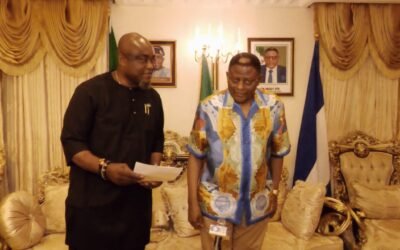
Ntufam Hilliard Eta, the appointed Chairman of the NYSC Federal Board awaiting inauguration, appears to be grappling with the perceived disconnect between the realities of Cross River State’s economy and the administration of Governor Bassey Edet Otu. Eta’s skepticism, particularly regarding the “Season of Sweetness” slogan—a term derived from Governor Otu’s long-held “Sweet Prince” nickname—reflects his concerns about the state’s economic trajectory. This nickname was embraced during Otu’s tenure in the Federal House of Representatives and the Senate and has been further adopted since his election as governor, alongside the administration’s “People First!” mantra.
In recent remarks, Eta questioned the authenticity of the “Season of Sweetness,” asserting that he sees “no change in the narrative and trajectory of Cross River State.” He cited a “high level of wants, poverty, and lack of economic opportunities” in the state, along with a noticeable absence of entrepreneurial activities.
Eta further claimed that Cross River State is currently at its “weakest” point, while acknowledging reports of increased internally generated revenue, albeit without concrete data. He called for accountability, suggesting that the Otu administration has received significantly more in federal allocations during its two and a half years than its predecessor did over eight years. He posed the critical question, “How can we cultivate the next generation of entrepreneurs in Cross River State?”
READ ALSO: Anambra NLC joins nationwide protest against insecurity in Nigeria
This response aims to clarify and address Eta’s concerns, focusing on how Governor Otu’s administration is nurturing the next generation of entrepreneurs and how the governor is judiciously utilizing the increased revenue from federal allocations and internal generation efforts.
Governor Otu’s administration is actively fostering entrepreneurship through transparent accountability and a focus on community development. Notably, the administration has developed a comprehensive 10-year development plan for 2024 to 2033, with quarterly budget reports available online. Under Governor Otu’s leadership, the Micro Enterprise Development Agency has been rebranded as the Cross River State Enterprise Development Center (CRSEDC), significantly enhancing its visibility and identity as a state-led hub for entrepreneurship. The center has trained over 2,500 participants across the 18 local government areas, improving business skills, financial literacy, and startup readiness at the grassroots level.
The CRSEDC has also strengthened MSME registration, tax onboarding, and compliance training for entrepreneurs, fostering institutional linkages between state-level enterprise support and federal agencies. Over 100 beneficiaries have reported that, after training in creative and digital economy partnerships, they received startup capital support. The administration has supported 5,000 nano businesses with N50,000 each, liquidated N200 million from the CRSG-BOA fund, and successfully profiled 500 beneficiaries who have received payments. Additionally, 2,315 MSMEs across the state have been awarded grants ranging from N100,000 for nano businesses to N400,000 for small enterprises. Furthermore, 500 retirees have been trained and equipped with starter packs.
Under the Ministry of Wealth Creation, 8,168 nano businesses have been registered and trained. In the 196 wards of the state, more than 200 Cross Riverians have received POS machines and N150,000 each to launch micro-enterprises, directly contributing to rural economic activity. Additionally, over 200 youths have been trained in integrated agriculture, and a digital transformation initiative has been established in collaboration with NUGI Technologies and the State Bureau of Statistics, resulting in a digital data bank to support policy planning. The state has deployed desk officers to the 18 LGAs to manage and operationalize the data system, providing real-time insights into labor market conditions. Importantly, the state has inaugurated the first MSME Council, aligning Cross River State with the National MSME Council chaired by the Vice President, thereby solidifying its position among Nigeria’s leaders in MSME reform. A comprehensive five-year MSME Development Strategy for 2024-2028 is in place, encompassing training modules and institutional reforms aimed at enhancing the productivity and reach of micro and small businesses statewide.
These initiatives represent just a portion of the government’s efforts to drive investment and entrepreneurship. Recent actions include the debt buyback of Tinapa Business Resort, the revitalization of agricultural estates such as the former Cross River Rubber Estate, now Uyanga Oil Palm Estate under Wilma Limited, and the Boki Nsadop Palm Estate, now managed by Presco Limited.
Opportunities abound in the state, with agencies and institutions available to assist potential investors in sectors such as tourism, the digital economy, agriculture, the marine economy, real estate, oil and gas, and industrialization.
Addressing Eta’s inquiry about how the governor has judiciously utilized the increased revenue from federal allocations and internal generation efforts is essential.
It is important to acknowledge that achieving over a 150% increase in internally generated revenue requires a governor with fiscal discipline. The state IRS has generated a total of N90 billion in two years under Governor Otu, compared to N43 billion in the previous two years of the last administration, reflecting a growth of 109%. Average monthly collections increased from N1.7 billion to N4.5 billion as of May 2025, representing a growth of 165%.
The removal of the petrol subsidy and economic re-engineering at the federal level have also contributed to increased federal allocations to states. While Governor Bassey Otu has a vision for state development, his blueprint includes rebuilding and restoring meaningful programs initiated by his predecessors.
So far, the governor has focused on rebuilding the state civil service, lifting a ten-year employment embargo and hiring over 5,000 civil servants. The minimum wage has been increased from less than N20,000 to N70,000. Arrears of retirees’ gratuities dating back to 2012 have been addressed, with N10 billion approved to tackle the backlog for those from 2012 to 2015. Additionally, the governor has worked to reduce the state’s debt profile by over 50% in two years, as verified by the Federal Debt Management Office.
With the increased revenue, the government has undertaken significant infrastructure development, including rural and urban roads, bridges, erosion control, and the refinancing of unfinished projects from previous administrations, such as Bakassi Deep Seaport and the Obudu passenger and cargo airport. These developments are evident to those who choose to view them objectively.
In conclusion, the Governor Otu-led administration welcomes constructive criticism as a means of gauging public sentiment and making necessary adjustments. Much has been achieved through listening to objective feedback.
Even when criticisms are subjective, the Governor Otu-led government remains open to them, discerning valuable insights from less credible claims. However, when criticisms are based on falsehoods, half-truths, and misinformation, they become a malicious attack on a governor committed to effective governance. Such actions are unjust.
The path to greatness for Cross River State requires collaboration, unity, and truth, rather than division and unverifiable claims. Governor Bassey Otu’s administration is not merely promoting a slogan; it is executing a reform agenda focused on fiscal discipline, enterprise development, social protection, and long-term planning. While progress may not be instantaneous, it is measurable, intentional, and unfolding across various sectors. The real danger lies not in constructive criticism but in ignoring the facts that clearly demonstrate a state committed to rebuilding its economy, restoring public confidence, and laying the foundation for sustainable prosperity.
Nsa Gill is the Special Adviser on Public Affairs to the Governor of Cross River State.