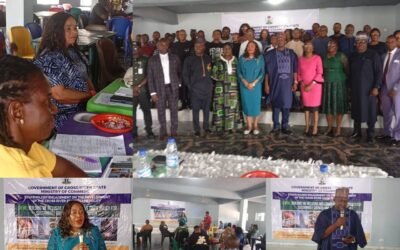






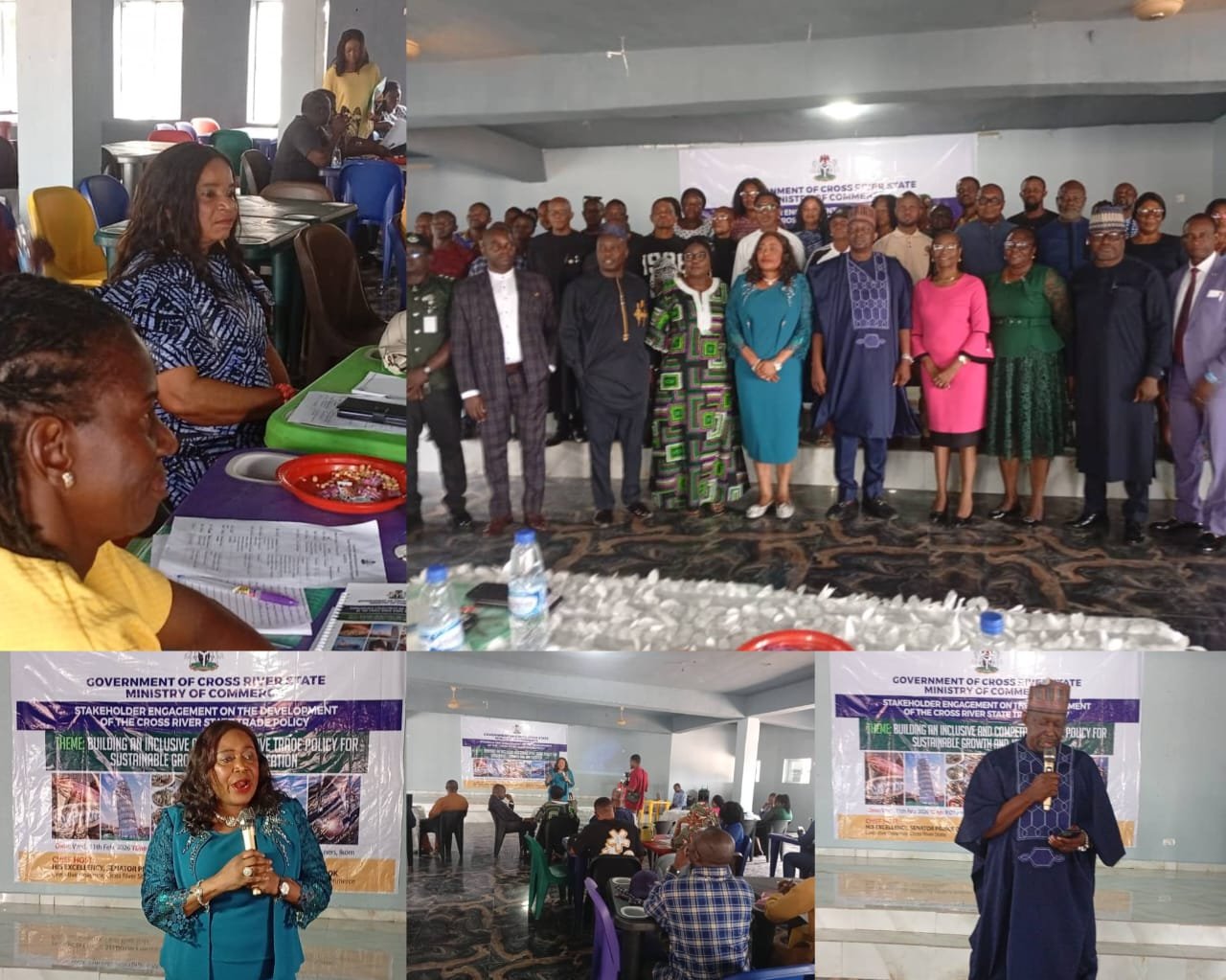
Key stakeholders within the agricultural and commercial value chains recently converged in Ikom Local Government Area of Cross River State to contribute to the development of a comprehensive Cross River State Trade Policy aimed at driving sustainable growth and job creation.
The high-level Stakeholder Engagement Workshop formed part of a broader consultative process spearheaded by the Cross River State Ministry of Commerce to institutionalize a structured, inclusive, and competitive trade framework for the state.
In line with the Ministry’s mandate to facilitate, regulate, and promote trade within the state, the Honourable Commissioner for Commerce, Dr. (Mrs.) Abigail Duke Orok, on behalf of the State Governor, Sen. Prince Bassey Edet Otu had earlier inaugurated a Trade Policy Development Committee to drive the formulation of a robust policy framework. The Committee has since commenced structured stakeholder engagements across the three senatorial districts to harvest critical inputs and ensure inclusive participation from all segments of the trade ecosystem, with the Ikom engagement focusing on stakeholders within the Central Senatorial District.
READ ALSO: Road infrastructure behind Gov Soludo’s second term victory in Anambra 2025 guber poll – Mbonu
The workshop, themed “Building an Inclusive and Competitive Trade Policy for Sustainable Growth and Job Creation,” brought together farmers and producer groups, cooperatives, local traders and SMEs, traditional institutions, local government representatives, MDAs and regulatory agencies, private sector actors, and development partners to deliberate on shaping a trade framework that promotes fairness, value retention, investment attraction, and inclusive economic development across the state.
Declaring the workshop open, the Member representing Akamkpa I State Constituency, Ntufam Okon Owuna, charged stakeholders to demonstrate strong commitment to the process to ensure the smooth development and effective implementation of the proposed policy. He emphasized that the success of the Trade Policy would depend on collective ownership, sincerity of purpose, and active engagement by all participants.
In her welcome remarks, the Honourable Commissioner for Commerce, Dr. (Mrs.) Abigail Duke Orok, described the engagement as a groundbreaking initiative, noting that it represents the first State-level Trade Policy development process of its kind in Cross River State. She attributed the laudable initiative to the visionary leadership of the “People First” Governor, His Excellency, Sen. Prince Bassey Edet Otu, and stressed that consultative engagements are critical to crafting a policy that genuinely reflects realities on the ground.
According to the Commissioner, the policy development process is designed to institutionalize fairness in trade practices, strengthen regulatory enforcement, enhance producer protection, and create structured opportunities for private sector participation. She called for constructive and practical contributions from all stakeholder groups to ensure that the final document is inclusive, evidence-based, and implementable.
Goodwill messages were presented by notable stakeholders including, the State Economic Adviser, Prof Peter Oti, representatives of Cocoa Association of Nigeria, Cocoa Farmers Association of Nigeria, Civil society organisations, Calabar Chamber of Commerce, Industry, Mining and Agriculture, as well as Ikom Chamber of Commerce, Industry, Mining and Agriculture who pledged their commitment to a successful policy development process.
They commended the Honourable Commissioner and her team for driving the initiative and providing an inclusive platform for dialogue and policy co-creation.
Presentations on the current trade environment in Cross River State, particularly within the Central Senatorial District, as well as the proposed strategic pillars for transforming trade and local economies, led into technical breakout sessions where participants critically reviewed the draft policy document. Farmers, cooperative leaders, traders, and regulators provided practical insights into pricing challenges, market access constraints, regulatory gaps, and the impact of unfair trade practices on rural livelihoods.
Discussions revealed concerns around price suppression in rural communities, weak market coordination, inadequate enforcement of standards, and limited access to structured markets—factors believed to undermine value retention within the state. Stakeholders identified priority gaps requiring urgent attention and proposed practical policy directions to address them. They also evaluated whether the proposed strategic pillars of the Trade Policy adequately address sector challenges, identified possible overlaps or omissions, and discussed priority areas for early implementation.
The breakout sessions further recommended stronger local coordination mechanisms, improved regulatory enforcement, enhanced producer protection, and structured engagement of private investors, while institutions clearly outlined the roles they can realistically play in implementation, monitoring, and enforcement of the policy. It is expected that the workshop outcomes will directly inform the final Trade Policy document, strengthen mechanisms to protect local enterprises, enhance value chain development, and promote fair and sustainable trade practices across the state.
The Trade Policy Drafting Committee is chaired by Prof. Susan Ohen, with membership comprising Prof. Frances Obafemi, Prof. Peter Oti, Prof. Lionel Effiom, Mr. Kelly Ayamba, Barr. William Itorok, Mr. Kenneth Asim Ittah, and Dr. Pamela Ekuri, while Mr. Louis Ibok serves as the Secretary to the Committee.